Editorials
INEC setback, APC panic? Court judgment reopens 2027 political battlefield

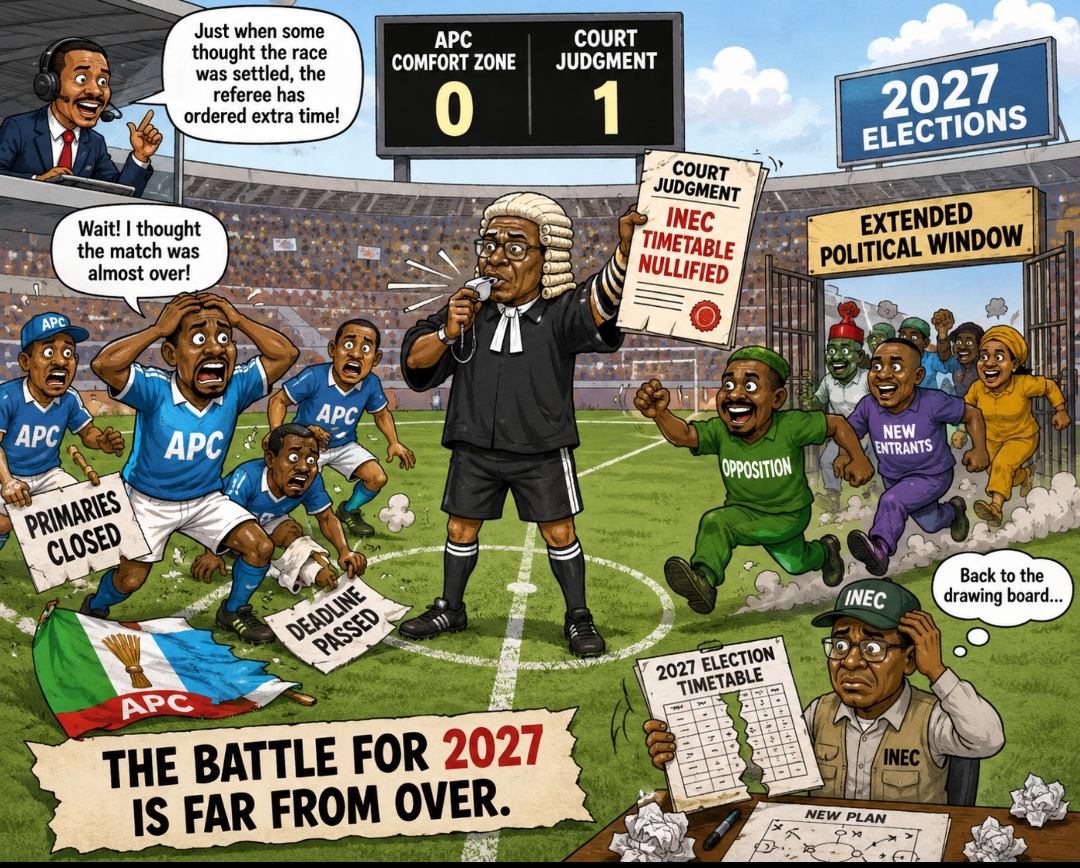
With less than one year to the 2027 general elections, Nigeria’s political landscape may have been dramatically altered by a Federal High Court judgment that nullified key aspects of the Independent National Electoral Commission’s electoral timetable, a ruling already being celebrated by opposition parties as a major victory against what they describe as an attempt to restrict political competition.
The judgment has not only unsettled INEC’s preparations for the next election cycle but has also reopened political doors that many believed had already been shut.
At the centre of the controversy was INEC’s revised timetable, which required political parties to submit their membership registers early, conduct primaries within a strict timeframe and conclude critical nomination processes months ahead of statutory deadlines provided under the Electoral Act 2026.
However, Justice Mohammed Umar ruled that the electoral commission lacked the legal authority to impose timelines that effectively abridged periods expressly granted to political parties by law.
The verdict effectively dismantles portions of INEC’s carefully structured roadmap to 2027 and hands political parties greater flexibility in managing their internal affairs, including membership registration, candidate nomination, withdrawal and substitution processes.
For opposition parties, the judgment represents much more than a legal victory.
It potentially revives the ambitions of politicians who may have felt trapped within their current political platforms due to restrictive deadlines and membership requirements.
Under the now-nullified guidelines, political actors seeking alternative platforms would have faced significant hurdles, particularly those considering last-minute defections after losing party primaries.
With the court creating a wider political window, the possibility of fresh alliances, defections and realignments has suddenly become more realistic.
It is perhaps for this reason that the African Democratic Congress quickly declared that Nigerians would soon witness a mass exodus from the ruling APC.
Whether that prediction materialises remains uncertain, but there is little doubt that the ruling has injected fresh energy into opposition politics.
The decision also reinforces a fundamental democratic principle: that administrative regulations cannot override statutory provisions enacted by law.
By affirming that INEC cannot shorten timelines already provided by the Electoral Act, the court has drawn a clear line between regulatory authority and legislative powers.
Yet the ruling presents fresh challenges.
For INEC, the judgment threatens to complicate electoral planning. The commission has repeatedly argued that earlier deadlines provide the operational flexibility necessary to process candidate information, resolve disputes and prepare adequately for elections.
Without those administrative buffers, the task of managing a nationwide election may become more difficult.
That concern was reflected in the reaction of INEC officials, who argued that statutory deadlines represent the latest possible dates under the law and not necessarily the most practical deadlines for election administration.
Nevertheless, the court’s position remains clear: convenience cannot supersede legality.
The verdict also raises broader political questions.
Was INEC genuinely attempting to streamline election management, or were the guidelines inadvertently creating barriers that could have limited political competition?
Opposition parties have long argued that some of the commission’s recent decisions appeared designed to narrow the democratic space rather than expand it.
The court’s judgment may now strengthen those arguments and intensify scrutiny of future electoral regulations.
Beyond the legal and political implications, the ruling is a reminder that Nigeria’s democratic institutions remain subject to constitutional checks and balances.
In a period where public confidence in elections continues to face significant challenges, judicial oversight of electoral processes may prove critical to sustaining trust in the system.
For now, the judgment has shifted the political calculations ahead of 2027.
Political parties have gained additional breathing space. Aspirants have more room to manoeuvre. Potential defectors have renewed opportunities. And opposition parties believe the battlefield has been reopened.
Whether INEC appeals the decision or moves swiftly to adjust its timetable remains to be seen.
But one thing is already certain: the road to 2027 has become far more unpredictable, and the political contest ahead may now be even more intense than previously imagined.


-

 Inside Nigeria2 days ago
Gov Alia names Mathematics Education scholar Eunice Ogbenyi acting HoS of Benue State
-

 Sports1 day ago
BREAKING: Football shock as Rivers United Bus crashes en route to President’s Cup match
-
 Inside Nigeria2 days ago
Oyo Kidnapping: Obi, Senate call for urgent action on victims’ release
-

 Inside Nigeria2 days ago
₦7.4bn/km Coastal road project completed in Rivers State — Julius Berger
-
 National News24 hours ago
Tinubu fills NDDC board vacancy with nomination of Zainab Marwa
-

 Inside Nigeria1 day ago
Daily Times at 100: Publisher commits N100m to NUJ infrastructure project
-

 Inside Nigeria7 hours ago
NSITF targets AI impact on Gig Workers, Platform Economy
-

 Editorials7 hours ago
Panic across Nigeria as fake school attack rumours trigger mass evacuation in FCT, Ogun, Oyo and Kwara